
Dr. Amar Bose:
the ideas behind the sound.
The founder of Bose Corporation approached loudspeaker design through listening as well as measurement. That curiosity helped create the research culture from which the 802 family emerged.
A professor with a different question.
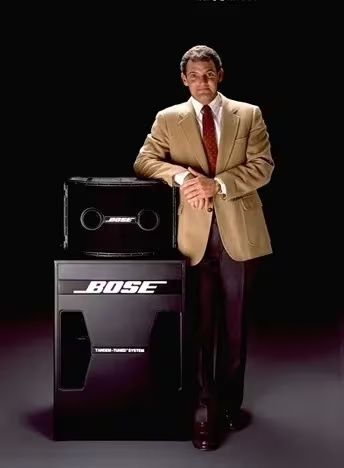
Dr. Amar Bose was an electrical engineer, an MIT professor and the founder of Bose Corporation. He established the company in 1964, building on research carried out at MIT. His academic career also included decades of teaching, alongside his work in acoustics and electronics. [1]
The question running through this story is deceptively simple: how do people actually experience reproduced sound? A good specification sheet is useful, but listening takes place in a room, with reflections, an audience and expectations shaped by live music.
The disappointing stereo.
Bose’s own history describes a sound system bought to celebrate the completion of his doctorate. Its published performance looked impressive, yet the listening experience disappointed him. He sought access to MIT’s acoustics laboratory to investigate why. [2]
That episode helps explain his interest in psychoacoustics—the study of how sound is perceived. The aim was to connect measurable behaviour with the experience of the listener, rather than assume that either could be understood in isolation.
From the 901 to professional sound.
The Bose 901 brought a multi-driver approach into home listening. Bose Professional’s history describes musicians and engineers subsequently using the 901 for sound reinforcement, revealing an application beyond domestic hi-fi.
The professional 800 and then the 802 developed that line of thinking for a different job: equipment that could be transported, positioned and used in venues. The original 802 was introduced in 1978. The connection is an evolving design approach, rather than a claim that a home loudspeaker was simply repackaged unchanged. [3]
Why eight small drivers mattered.
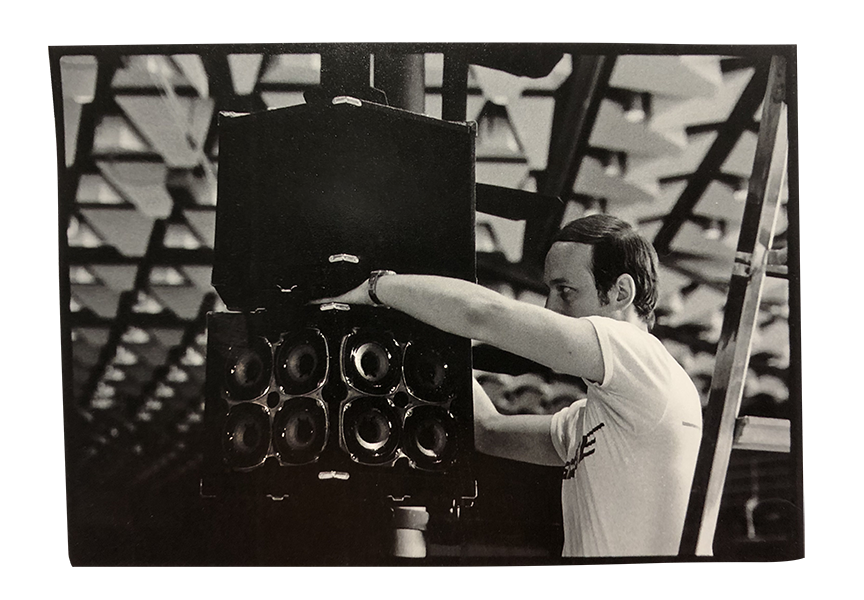
The 802 Series II uses eight 4.5-inch full-range drivers on a faceted Articulated Array baffle. Its published coverage is 120° horizontally and 100° vertically. This arrangement spreads sound across a broad area without a conventional woofer-to-tweeter crossover. [4]
That does not mean there is no electrical processing. The specified 802C Series II controller provides active equalization, and the loudspeaker includes protection and directivity-related circuitry. The driver array and processing belong to one system.
The distinction matters when maintaining an older pair. Replacing a driver with an arbitrary unit of the same diameter, or running the cabinet with unrelated EQ settings, changes the system that the engineering was designed around.
Rooms, reflections and coverage.
Bose’s early work explored how sound behaves in real listening spaces. That interest connects the home and professional stories, but the two applications should not be confused: the 901’s reflected-sound concept and the 802’s broad audience coverage serve different installation needs.
A wide array is a tool for system design, not a promise that every room will sound the same. Positioning, reflective surfaces, listening distance and additional cabinets still affect the result. Useful engineering begins with those conditions.
Independence and the MIT legacy.
MIT’s account of Amar Bose’s life emphasises his commitment to long-term research. In 2011, he gave MIT the majority of Bose Corporation’s stock as non-voting shares. The arrangement supports education and research through dividends; it did not give MIT a role in managing the company, and the shares cannot be sold. [1]
That is a significant legacy in its own right. It does not establish that the gift, or the decision to remain private, was made specifically to preserve the 802. The documented connection is the broader value placed on sustained research and education.
From the story to your system.
Explore the Series II guide for specifications and setup context, or identify the part needed to keep your own system useful.